Hasina sentence sparks political uncertainty in Bangladesh
Bangladesh grapples with Hasina verdict amid rising political tensions
Ousted Bangladesh Prime Minister Sheikh Hasina was given a death sentence by the country’s International Crimes Tribunal (ICT) for crimes against humanity. The verdict came after Hasina left Bangladesh on August 5 and took refuge in India. Despite this, her party, the Awami League, continues to maintain calm and strategic composure. Analysts say the verdict is unlikely to change the party’s long-term political course.
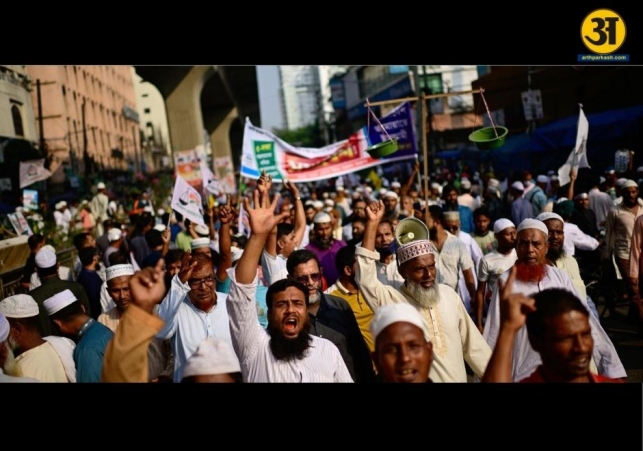
On November 13, four days before the verdict, the Awami League announced a “lockdown” program in Dhaka, which was the first public initiative since Hasina’s departure. Early reports suggested only 40 per cent participation, but later estimates indicated that nearly 70 per cent of the city complied. The party then announced a four-day series of programs, including a shutdown scheduled for the day before and the day of the verdict.
However, by November 15, the party quietly scaled down its focus on these activities. Analysts suggest that this was a deliberate move. Many senior leaders were in hiding, and very few were able to act on the ground. The Awami League likely reduced emphasis on public programs to conserve the energy of its workers and avoid unnecessary confrontation during this delicate period.
Another important reason for the restraint was political strategy. Launching a major protest against the verdict would have implied recognition of the current regime’s legitimacy, which the Awami League does not accept. The party maintains that the government that replaced it is an illegal occupier, and any confrontation could inadvertently give the regime credibility. By limiting activity, the Awami League has managed to show its strength without granting legitimacy to the authorities.
Historically, the Awami League has followed an aggressive political strategy rather than defensive politics. Even when top leaders appear conciliatory, these moves often serve larger strategic objectives. For example, in 1971, Sheikh Mujibur Rahman, the party’s founder, allowed himself to be arrested rather than go underground. Similarly, Hasina’s departure from Bangladesh on August 5 is seen as a calculated retreat, conserving her strength for future political action rather than a sign of weakness.
Observers, including retired freedom fighters, have described Hasina’s actions as strategically astute. Her leadership has consistently emphasized careful planning, long-term thinking, and maintaining organisational strength. The recent quiet retreat from active programs reflects the same approach. The Awami League continues to preserve its organisational capacity and maintain public support while avoiding direct confrontation that could give the current government legitimacy.
ALSO READ: Global alert issued as 6,000 jets face urgent updates to prevent flight-control failures
ALSO READ: UIDAI launches new feature allowing Aadhaar mobile update directly through app
Long-term strategy and political patience
The Awami League’s approach is shaped by decades of political experience. Historically, the party has sought to clarify Bangladesh’s political landscape by defining two main currents: a religious fundamentalist current and a land-and-culture-based Bengali nationalist current. The Awami League positions itself as the counterbalance to cultural-nationalist forces, allowing the political field to be clearly divided while maintaining stability in governance.
Sheikh Hasina’s interviews and statements underline this long-term strategy. She has emphasized that the party will continue to exist regardless of whether it is in power. Her goal is to promote an inclusive electoral system in Bangladesh. Hasina’s political project has consistently aimed to create clear ideological divides, enabling politics to stabilize within this framework.
Past decisions by Hasina reflect this mindset. During the anti-Ershad movement, efforts to unite Hasina with her rival Khaleda Zia were ultimately rejected by Hasina, who prioritized long-term strategic clarity over short-term alliances. In 1988, when an assassination attempt occurred in Chittagong, Hasina refrained from joining protest programs with rival political forces, showing her preference for independent political strategy. Similarly, in 1991, when BNP became the largest party, she refused to support it, despite pressure from intellectuals, to prevent strengthening religious fundamentalists.
Even now, the Awami League shows patience and composure in the face of setbacks. Hasina and her party workers continue to communicate with supporters through social media, highlighting that tens of millions of people in Bangladesh remain loyal to the party. Media outlets sympathetic to the current government acknowledge this, repeatedly questioning where the Awami League’s vote will go and how its supporters might act.
The verdict against Hasina, while serious, does not automatically change the party’s political path. Analysts note a clear asymmetry in Bangladesh’s political environment: the Awami League remains patient, composed, and strategically focused, while those who came to power through engineered processes appear restless and anxious. This contrast is expected to influence Bangladesh’s political rhythm in the coming months.
In conclusion, the Awami League’s calm response to the death sentence against Sheikh Hasina reflects a long-standing strategic approach. The party has historically combined patience, strategic retreats, and calculated public actions to maintain strength and public support. Its focus on ideological clarity, organisational resilience, and long-term political goals suggests that the party will continue its political journey without being derailed by the verdict. Meanwhile, the current ruling authorities’ impatience may work to the Awami League’s advantage, reinforcing its position as a key force in Bangladesh’s political landscape.
Related News